Fan blade is not only an important part of industrial fan, but also a key factor for the performance of industrial fan. After years of R&D and testing, Vanse
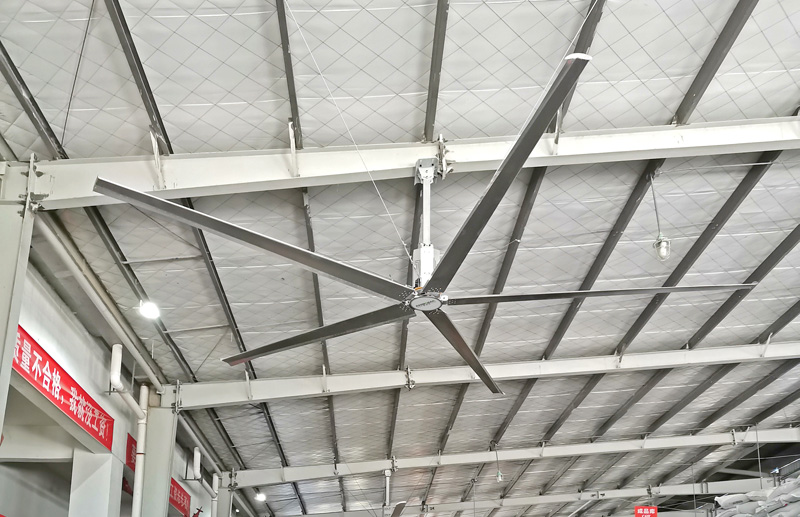
large industrial fan has continuously adjusted various parameters and actual operation, invented the unique variable cross-section streamlined 5-blade fan in the industry, and obtained the corresponding invention patent. Compared with the common 6-blade and equal cross-section blades on the market, the fan has wider coverage, lower energy consumption and larger air volume.
Vanse Large Industrial Fans Blade
The performance of large industrial fan blade is affected by many parameters that restrict each other, such as blade shape, blade inclination, blade spacing, blade thickness, blade number, blade attack angle, blade tip clearance, blade width, spindle diameter, etc. After continuous testing and adjustment, Vanse industrial fan has made a balanced design for the fan blades, taking into account the following factors:
Blade shape
The common fan blades are of equal cross section, while the Vanse ventilation blades was based on Joukowski’s design of the wing’s section (Zhukovsky, a famous Russian aerodynamics scientist and pioneer of contemporary aviation science, proposed the Zhukovsky function and laid the theoretical foundation for wing aerodynamic calculation), and then rotated and stacked according to the design needs, the included angle between the blade root and tip and the rotating axis, the root and tip width and other data to form a three-dimensional fan blade curve, Finally, the whole fan blade model design is completed by curve fitting, and the variable cross-section streamlined fan blade is made more compatible with the aerodynamic principle.
Blade curvature
In a certain range, at the same rotation rate, the greater the blade curvature, the greater the gas kinetic energy, that is, the greater the air volume and air pressure. At the same time, the greater the resistance of the blade, the greater the torque of the motor.
Blade inclination
The greater the inclination angle, the greater the pressure difference between the upper and lower surfaces of the blade, and the greater the wind pressure at the same rotation rate; However, if the pressure on the upper surface is too high, backflow may occur, which will reduce the performance of the fan. Therefore, the inclination angle of large industrial fan blades should also be increased within a certain limit.
Blade spacing
If the spacing between the blades is too small, it will lead to airflow disturbance, increase the friction on the blade surface and reduce the fan efficiency; If the spacing between blades is too large, the pressure loss will increase and the wind pressure will be insufficient. Factors must make the blade spacing design of industrial large fan within a reasonable range.
Blade number
The reasonable number of blades of the large industrial fan is odd numbers such as 3, 5 and 7. This is because if the even number of symmetrical blades are used and the balance is not adjusted well, it is easy to cause resonance of the system. If the blade material can not resist the fatigue caused by vibration, the blade or spindle will be broken. Therefore, Vanse industrial large fan adopts the design of odd number of blades (5 blades).
Blade smoothness
This is an index influenced by non-design factors, which basically depends on the die-forming and post-treatment process of the producer. Outside the design curve, the unevenness on the blade will produce turbulence during rotation, increase friction, reduce fan efficiency, damage fan performance and increase noise. Therefore, Vanse strictly controls the smoothness of blade surface during production.
Blade vibration
Large industrial fans are generally made of aluminum alloy. The fan blades have certain toughness and can withstand a certain degree of physical deformation. They will also vibrate due to force in the process of pushing the air, but the amplitude is generally small. The other serious vibration is due to the uneven mass distribution of the fan blade and the eccentricity between the mass center and the rotating axis. When the fan blade area (mass) or eccentricity is large, it may drive the fan and even the radiator to vibrate, and then affect the whole chassis.
The wind noise may occur from the collision of flowing air, friction between surrounding objects, the separation effect of blades on air flow, and the pulse force of periodic air supply. The faster the air velocity, the more turbulence, the greater the wind noise which will increase dramatically with the increase of wind speed. The main impact of noise is reflected in the physical and mental health and safety of users, while the vibration accompanied by noise may lead to click wear, loose interface, disc scratch and other phenomena endangering the use.
Vanse ventilation is one of a few large industrial ceiling fan manufacturers with self-built production plants, in which all the main design components are produced, and will not be purchased and assembled from outside. We pay attention to the optimization and R&D of various components of large industrial fan. Vanse focuses on the R&D and production of large industrial fan!




 jed@vansefans.com


