

Harmful gases which are deposited in the production plant are often produced in the production process in many industrial and manufacturing industries. Therefore, how to eliminate harmful gases is related to the staff health in the production line. For example, in the zinc electrowinning workshop of the smelter, acid mist, water vapor and heat are continuously evaporated on the surface of the open washing tank in the workshop. In order to reduce air pollution, comprehensive ventilation is required. The conventional practice was to set a skylight or ventilator on the roof of the workshop, use the thermal pressure or wind pressure caused by the indoor and outdoor temperature difference for natural exhaust, and set openable windows on the outer walls around the workshop for natural air intake. This method has the following disadvantages. First, due to volatile factor of the outdoor wind speed and temperature, it will result in unstable ventilation. Second, the air distribution is poor that the working point far away from the outer window of the workshop is polluted greatly. The outer window will be seriously damaged if eroded by acid gas for a long time. Third, acid mist is directly discharged, which is not conducive to environmental protection.
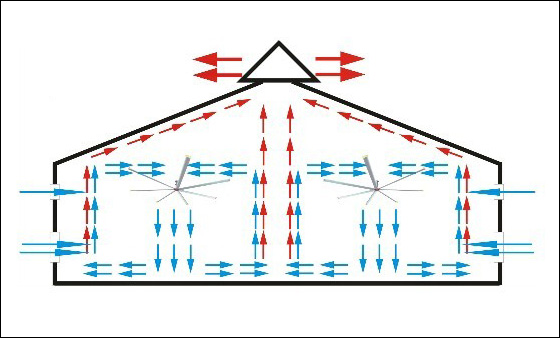
Therefore, in consideration of the plant generated harmful gases, with many years of ventilation experience, Vanse makes the large industrial ceiling fans adapted to the construction structure of the plant to provide a ventilation structure that can effectively reduce the damage of harmful gases to operators and reduce the corrosion to the plant.
The scheme is designed as follows. The wall of the plant is designed to be enclosed. There is an air inlet at the lower part of the wall. The workshop operation layer is overhead above the air inlet. Multiple exhaust outlets are opened on the roof. A through air duct is set above the exhaust outlet on the roof. An appropriate amount of large industrial ceiling fan is hung on the roof of the plant. In this technical scheme, the traditional ventilation mode of air intake from the window on the side of the wall is changed that to make the air intake at the bottom of the wall. The air is pushed from ceiling to floor through the industrial ceiling fan and then return to the roof again, so that the gas is discharged from the roof of the plant and flows into the natural air through the doors and windows of the plant, ensuring that the operator is at the upstream of the exhausted air. Therefore, fresh air always flows through the operator first, and then takes away the generated harmful gas upward.
Through this scheme, the large industrial ceiling fans make the fresh air flow upward directly from the operator's space, taking away water vapor, heat and harmful gases, which provides better protection for the operator. Moreover, because the air flow of the industrial ceiling fan is simulated natural wind and the wind speed can be adjusted as needed, it can meet the requirements of eliminating harmful gases at the same time, provide the staff with a comfortable and mild blowing feeling and create a good working environment for the operators.


 jed@vansefans.com


